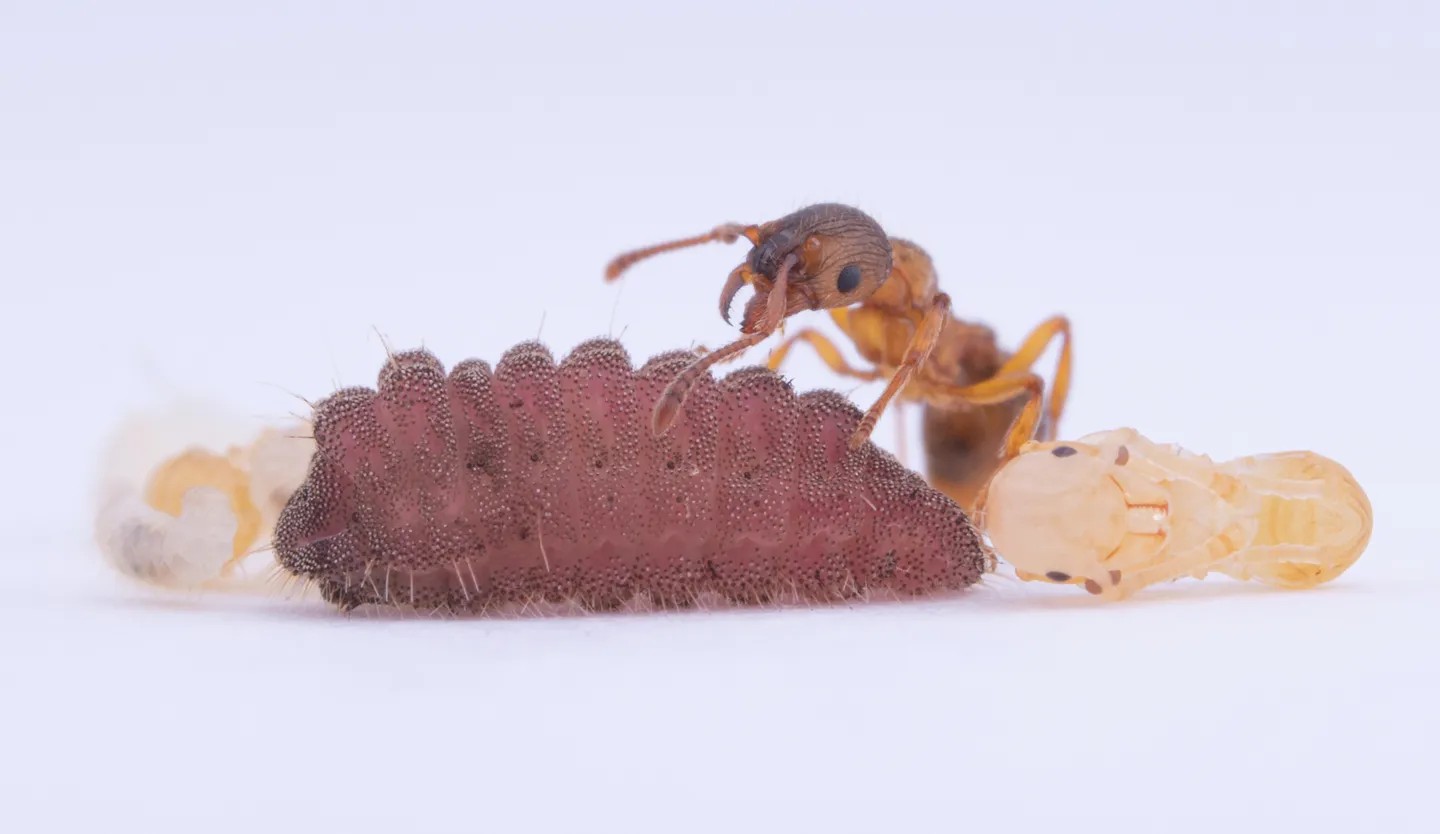
Researchers have discovered that certain caterpillars mimic the vibrational communication signals of ants to forge symbiotic – and sometimes parasitic – relationships. The findings, published in the Annals of the New York Academy of Sciences, suggest a surprising sophistication in insect communication and challenge assumptions about the rarity of rhythmic communication in the animal kingdom.
The Caterpillar-Ant Partnership
Many caterpillar species, particularly within the butterfly family, exhibit myrmecophily – a fondness for ants. These caterpillars have evolved close bonds with various ant colonies, including those of Tetramorium and Myrmica species. The nature of these relationships ranges from mutual benefit, where caterpillars provide sugary secretions in exchange for protection, to outright parasitism, with caterpillars feeding on ant larvae within the nest.
The key to these interactions lies in deception. Some caterpillars already mimic ant chemical cues, but new research indicates that they also copy the vibrational language of ants. This means vibrating in patterns similar to the way ant queens communicate with their colonies.
How They Communicate Through Vibration
Researchers at the University of Warwick studied nine caterpillar species and two ant colonies across Northern Italy. Using sensitive microphones, they analyzed the subtle vibrations produced by both insects while traveling through soil and other materials. The team discovered that caterpillars most reliant on ants for survival were able to produce complex rhythmic vibrations that precisely matched the ants’ communication patterns.
This includes maintaining consistent pauses between pulses and alternating between short and long spaces in the vibration sequence. By essentially “speaking the same language,” these caterpillars gain greater access to ant colonies, potentially securing food, protection, or even outright adoption into the nest.
Why This Matters
The ability of caterpillars to exploit ant communication systems raises questions about how widespread rhythmic communication might be among animals. While primates – including humans – exhibit complex rhythm recognition, it is still rare even among highly intelligent species. The discovery that insects can mimic and utilize these patterns suggests that keeping a beat may be more fundamental to animal communication than previously thought.
Luan Dias Lima, an entomologist at the University of São Paulo, suggests further research comparing these butterfly caterpillars with metalmark butterflies, which also form close relationships with ants. Identifying shared rhythmic patterns could reveal a universal language for insect-ant interactions.
“Observing comparable levels of rhythmic organization in ants was genuinely mind-blowing,” says researcher Chiara De Gregorio. The findings emphasize that communication isn’t just what is said, but how it’s said, even at the smallest scale.
This discovery underscores the complexity of insect behavior and highlights how seemingly simple creatures can exploit sophisticated communication systems for survival. The ability to mimic and adapt to another species’ language is a remarkable feat, and may reshape our understanding of animal intelligence and communication.