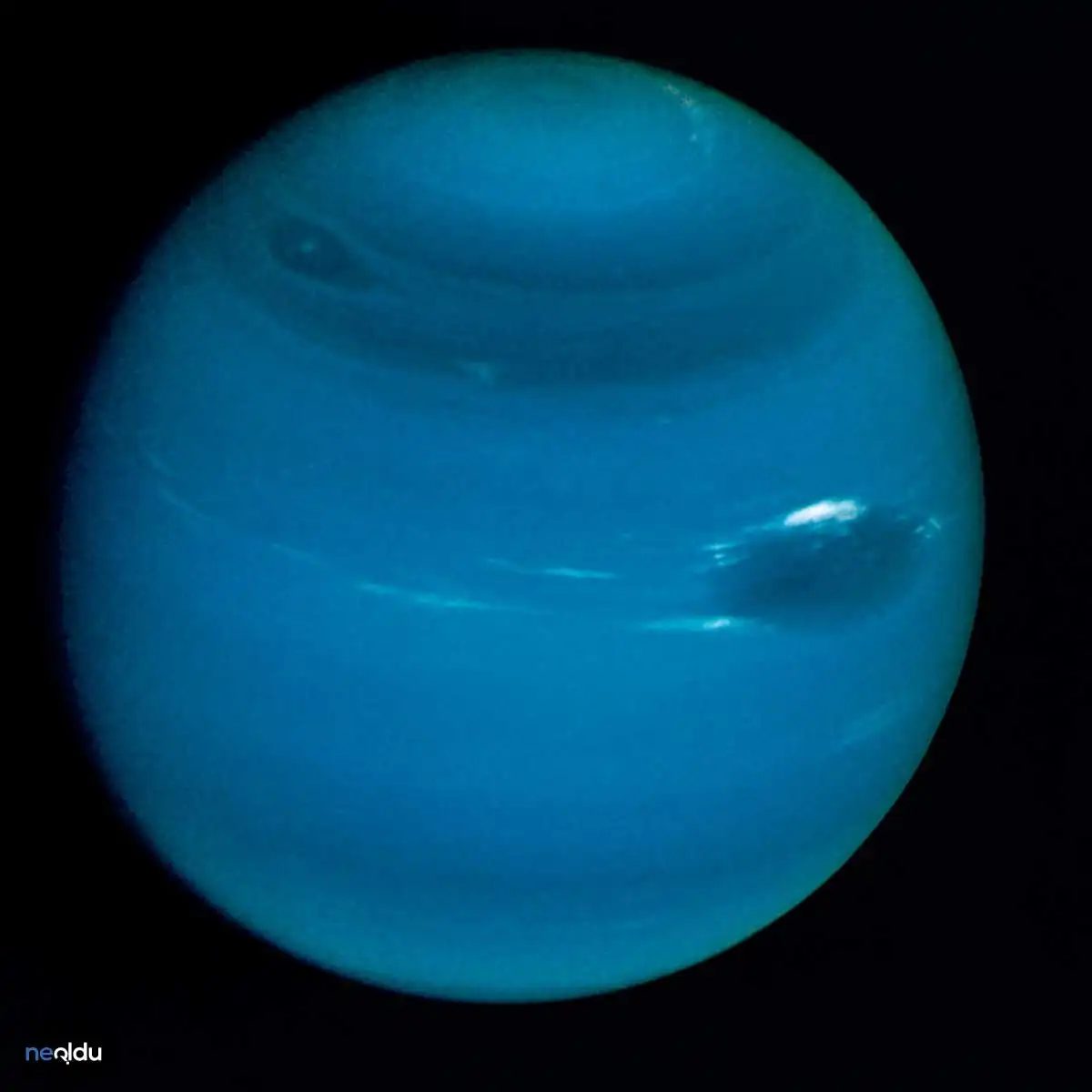
It is located at the edge of the known solar system, so far away that it takes more than four hours for sunlight to arrive. Neptune is the eighth and farthest planet from the Sun. It’s also a giant. Although Uranus is its neighbor in size, Neptune is denser and more massive. This ice giant hides behind a thick, turbulent atmosphere that looks deceptively calm from afar, but hides storms that can tear through the planet at supersonic speeds.
People often ask why Neptune is blue. The answer isn’t just in water ice like it is on Earth. It is methane gas in the upper atmosphere. Methane absorbs red light from the sun and reflects blue back out. You see a world shrouded in a deep, azure haze that hides a complex interior of rock, ice, and exotic fluids under crushing pressure.
Elliptical orbit and orbital mechanics
One of Neptune’s most distinctive features is its elliptical orbit. Unlike the nearly circular orbits of Earth or Venus, Neptune’s orbit is significantly elongated. This means that its distance from the Sun varies significantly over the course of a long year.
Its average distance is about 4.5 billion kilometers (2.8 billion miles). But because of this eccentricity, it can come closer to the Sun than Pluto at certain points in its orbit. This relationship is determined by the gravitational resonance with Pluto. They never collide. Their orbits are locked in 3:2 resonance. Every time Neptune goes around the Sun three times, Pluto completes two orbits. This cosmic dance prevents them from getting close enough to interact directly, even though their paths cross in three-dimensional space.
A world full of extreme weather conditions
The real drama takes place in Neptune’s atmosphere. It is the windiest planet in the solar system. Wind speeds here can reach over 2,000 kilometers per hour (1,200 miles per hour). These are not just gentle winds. They are powerful jets that orbit the planet and are powered not by solar energy but by internal heat.
Because Neptune is so far from the Sun, it receives very little heat from our star. Still, it radiates more heat into space than it receives from the Sun. This internal energy source powers violent weather systems. Scientists are still debating how this heat is generated, but the result is a dynamic atmosphere that changes rapidly.
The Great Dark Spot, discovered by Voyager 2 in 1989, was a storm system similar to Jupiter’s Great Red Spot. It was huge, twice the size of Earth. But when the Hubble Space Telescope looked back years later, the spot was gone. New storms appear and disappear in Neptune’s atmosphere at an alarming rate. This lack of long-term stability makes weather forecasting nearly impossible.
The Secret of the Blue Giant
Why is Neptune important? It helps us understand gas giants in other star systems. Most of the exoplanets discovered so far are “hot Jupiters” or “Neptunes” that orbit close to their stars. Studying our own Neptune gives us a basis for what these distant worlds might look like in their natural state. It is a laboratory for high-pressure physics and fluid dynamics under conditions we cannot reproduce on Earth.
The composition of the planet is mainly water, ammonia and methane
Neptune is more than just a point of light in the void; It’s a giant, frozen world. It is the fourth largest planet in the solar system after Jupiter, Saturn and Uranus. But its defining characteristic is its distance. It is the farthest planet from the Sun. Its name comes from the Roman god of the sea, an apt title given its turbulent nature. It is anything but calm.
-
Size: The radius of Neptune is about 24,000 kilometers. Although it is the third largest planet by volume, its mass is about 17 times that of Earth.
-
Orbit: It holds the title of the most distant planet in our solar system. It orbits the sun at an average distance of 4.5 billion kilometers. One revolution takes 165 Earth years. Its orbit is highly elliptical, meaning that its distance from the Sun varies significantly throughout the year.
-
Atmosphere: The atmosphere is a chaotic mixture of hydrogen, helium and methane. Methane in the outer layers absorbs red light and reflects blue, giving the planet its iconic color. The winds are wild here. They can reach speeds of 2,000 kilometers per hour, making them the Fastest in the Solar System – faster than any hurricane recorded on Earth.
-
Moons: Neptune has at least 14 known natural satellites. Triton is the largest and fifth largest moon in the solar system. Unlike most moons, Triton orbits retrograde, rotating in the opposite direction to the planet’s rotation. Several other moons follow irregular orbits.
-
Surface: Like other gas giants, Neptune does not have a solid surface. As you dive deeper into the dense, gaseous atmosphere, the pressure increases until the gases become liquid. We know very little about what lies beneath this thick shroud.
Why is Neptune so cold?
If you’re wondering about temperature, the answer is at this distance. Neptune is a cold place. The average temperature at the tops of the clouds is about -214 degrees Celsius (-353 degrees Fahrenheit). For perspective, it’s colder than Pluto.
But here’s the twist. Despite being so far from the Sun, Neptune radiates more heat into space than it receives from it. Why? The planet has an internal heat source. Scientists believe that the residual heat from its formation, combined with gravitational compression, keeps its core warm. This internal energy drives these supersonic winds, creating a dynamic weather system that is surprisingly active for such a distant world.
So is it just a frozen ball of ice? No. It is a complex, turbulent atmosphere fueled by its own internal fire, harboring a core that remains hot and active even in the deep freeze of the outer solar system.
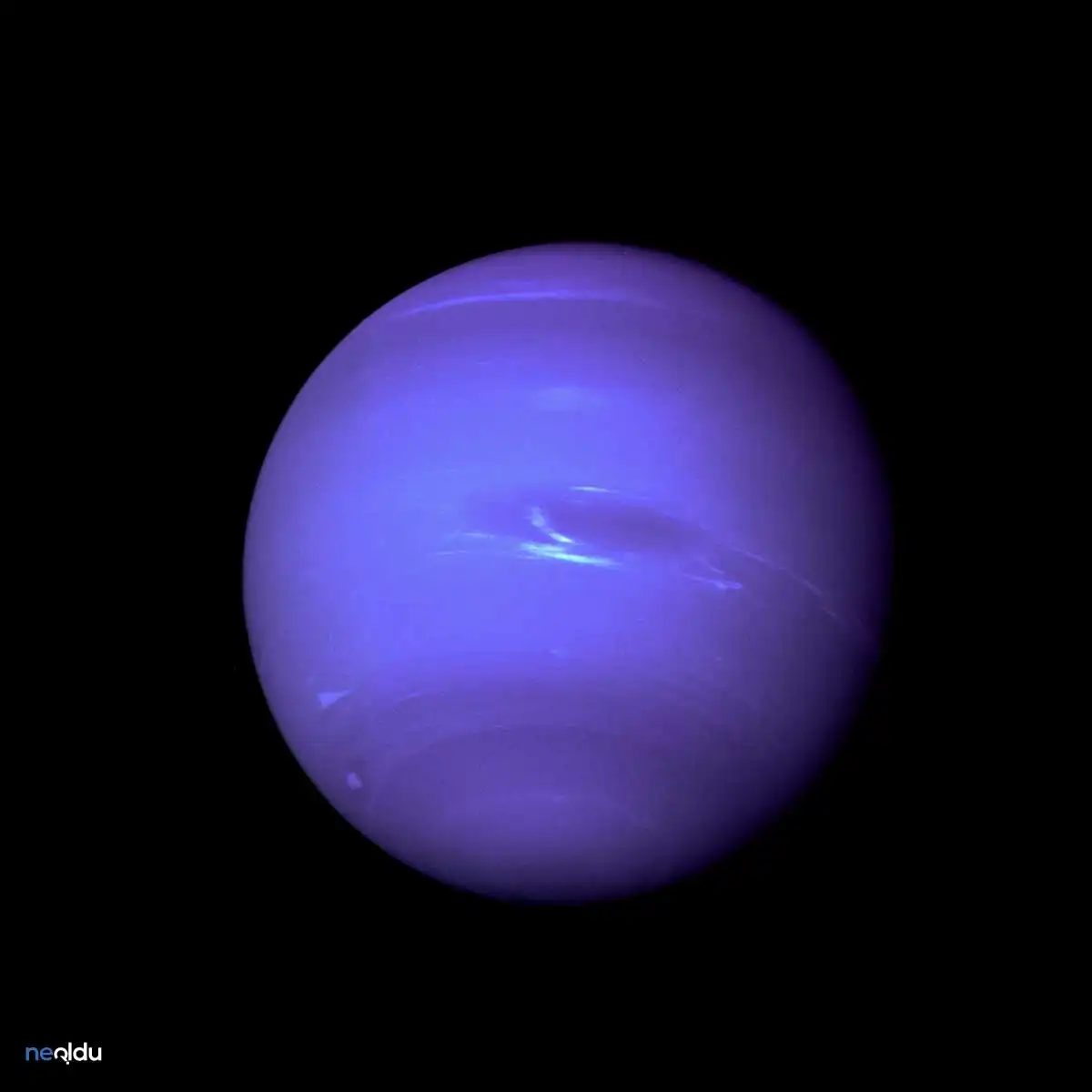
Mechanics and rotation of Neptune’s orbit
Neptune is on the edge of the known solar system. It’s cold. The average temperature is about -214 degrees. But the cold is not uniform. The upper atmosphere tells a different story. There, the temperature rises to around -200 degrees. Why? The sun’s strong ultraviolet radiation heats this thin layer. It’s a weird thermal inversion. Dive deeper into the planet and the heat disappears. The sun’s energy is weak at this distance. When you descend, it’s colder inside. This gradient defines Neptune’s character. It separates the blue giant from its neighbors. The color comes from methane. Temperature comes from physics. Both make it unique.
Neptune’s orbit and rotation
Neptune takes about 165 Earth years to orbit the Sun. A day on Neptune lasts only 16 hours. The planet spins fast. It is the windiest world in the solar system. The wind speed can be up to 2000 kilometers per hour. That’s supersonic. The rapid rotation flattens the planet slightly at the poles. It creates a distinct oblate shape. The track is almost circular. But it still takes centuries to complete the circuit. Voyager 2 flew by in 1989. It gave us our best look. Since then we have only watched from afar. The cold keeps us away. Speed makes it dynamic. It’s a world of extremes.
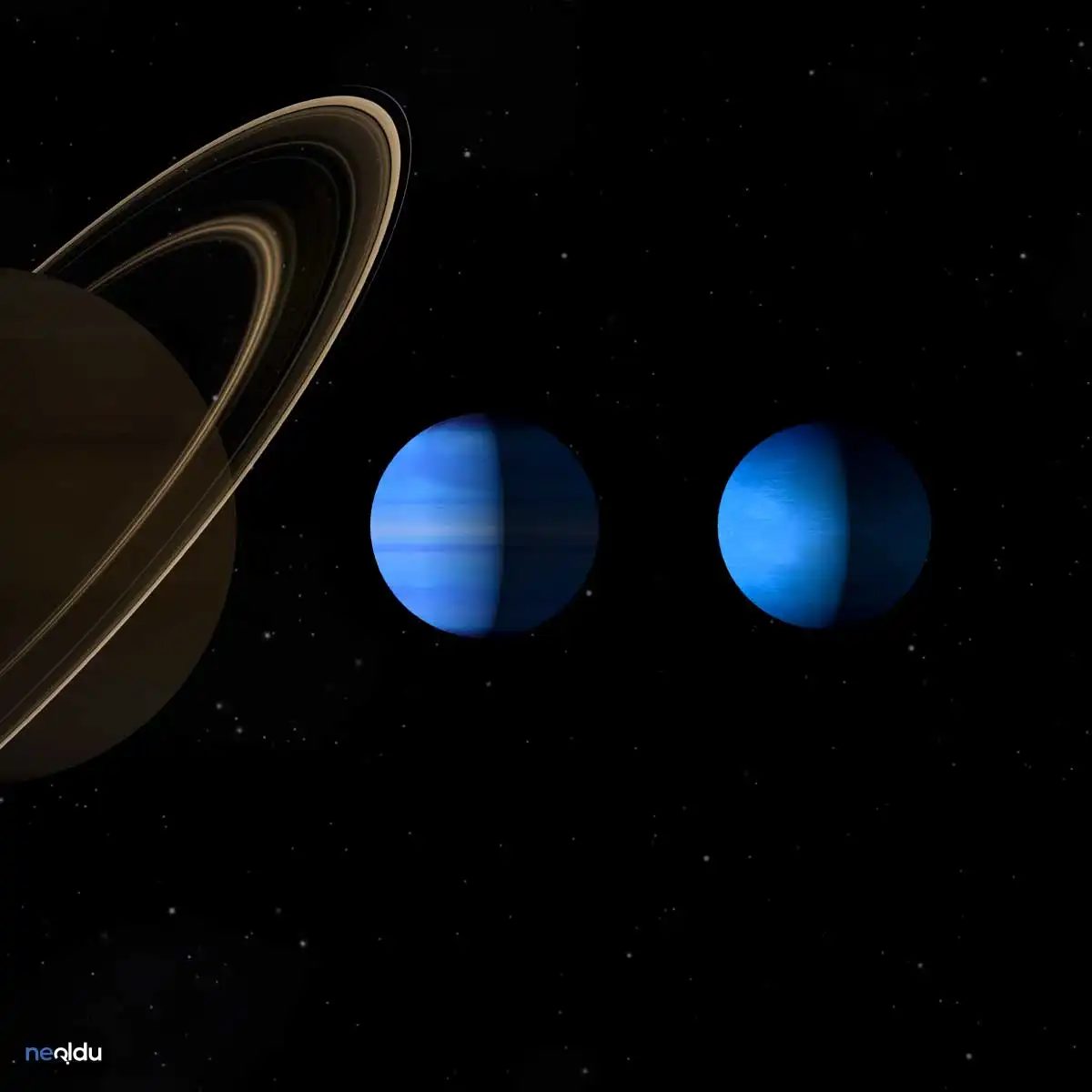
Dance of the Outer Giant
Neptune is the farthest planetary from the Sun and is the eighth planetary in our solar system. Its orbit is not a neat circle; it is quite elliptical. This means that the distance from the Sun changes significantly over time. One round takes about 165 Earth years. Due to its great distance and pace, it is one of the slowest moving planetarys in the system.
But the rotation tells a different story.
A day on Neptune is surprisingly short and lasts only about 16 hours. This rapid spin has consequences. It doesn’t just cause the planetary to flatten at the poles. A chaotic magnetic field is created. The axis is inclined at 28.32 degrees. This tilt causes the planetary to wobble throughout its orbit, causing significant seasonal climate changes during its long year. The rapid rotation combined with the tilted axis creates violent winds and a distorted magnetic environment.
Strange Moon: Triton
Neptune is not alone in the dark. It is surrounded by rings and a cluster of moons. But one stands out.
Triton is the largest of these satellites. It is significantly larger than any other moon in the system. Things are strange in its orbit. Triton moves backwards.
While Neptune and its other moons rotate in one direction, Triton orbits in the opposite direction. This retrograde motion suggests that it did not form with the planetary. Neptune’s gravity likely captured it long after the solar system had settled down. This makes Triton a strange guest in a house it didn’t build.
Triton’s retrograde orbit implies a violent capture event that challenges standard models of planetary formation.
The presence of rings adds complexity. They are dim, dark, and structurally influenced by the pull of moons like Triton. This dynamic creates gaps and waves in the ring material, a constant gravitational dance.
Why is this important? Understanding Triton helps us understand how solar systems evolve. It shows that planetarys can change their families. Objects can be stolen. Orbits can turn. It reminds us that the solar system is not a static clockwork. It’s a chaotic, evolving place.
Neptune’s slow journey around the sun contrasts with the frantic energy of its atmosphere and the rebellious orbit of the largest moon. It’s a world of extremes. Far from the heat of the sun and still warmed by inner forces. Remote, but dynamically active.
We have only scratched the surface. Voyager 2 flew by in 1989. One glimpse. One flyby. The data is old. The mystery remains. What lies beneath that blue haze? We don’t know. Not yet.
Triton is not just a moon. It’s a frozen anomaly. Discovered by Voyager 2 in 1989, it holds the title of Neptune’s largest satellite and ranks among the coldest objects in the entire solar system. There, surface temperatures can drop to -235 degrees Celsius. It’s cold enough for nitrogen to freeze solid. But despite the deep frost, the surface is not dead. Geological activity has been detected. Cryovolcanoes likely spew nitrogen gas and dark dust into the thin atmosphere, a stark contrast to the static ice fields we see elsewhere.
Beyond Triton, the system becomes chaotic.
Nereid orbits much farther. It has one of the most irregular orbits in the Solar System, swinging from close proximity to vast distances. Its orbit suggests that it may be a captured asteroid that was pulled in by Neptune’s gravity long ago. Then there’s Proteus. As Neptune’s second largest moon, it is a battered rock. Its surface is a scarred map of impact craters showing little or no geological renewal. Larissa, the fifth largest, shares the same crater history but has unique surface markings that indicate more complex tectonic or erosional forces.
The rest of the retinue is a swarm of small, dark bodies. Thalassa, Despina, Galatea, Naiad, Sao, Laomedeia, Psamathe, Halimede, Neso and S/2004 N1 are mostly shadows in the data. They are small. They are low mass. They are poorly understood. Most astronomers admit they know more about Pluto’s moons than they do about these distant specks. It is hoped that future missions will peel back the darkness and revealing if these small moons are ancient remnants or recent collisions.
How Neptune’s weather defies physics
Looking at the gas giant itself, you wouldn’t think it was that cold. Neptune radiates twice as much heat as it receives from the Sun. This internal energy drives violent atmospheric dynamics.
The planet is shrouded in dark blue methane clouds that absorb red light and give Neptune its characteristic color. But methane is only the tip of the iceberg. Beneath the visible cloud cover, the atmosphere is a boiling engine. The winds here are the fastest in the solar system, reaching speeds of over 2,000 km/h (1,200 mph). To put that in perspective, these winds blow six times as fast as the strongest hurricanes on Earth.
Why are they so fast?
Scientists believe that the secret lies in internal heat. Since most of Neptune’s energy does not depend on the sun, its weather systems are powered by heat escaping from the planet’s core. This creates a buoyancy effect that fuels super-rotating jet streams. Unlike Jupiter, which has stable, band-like storms, Neptune’s storms are transient. They form, develop and dissipate over months or years.
The Great Dark Spot observed by Voyager 2 in 1989 was a massive anticyclonic storm roughly the size of Earth. When the Hubble Space Telescope looked back at Neptune in 1994, the spot was gone. Since then, new dark spots have appeared, but their lifespans are short. This unpredictability makes Neptune’s climate one of the few
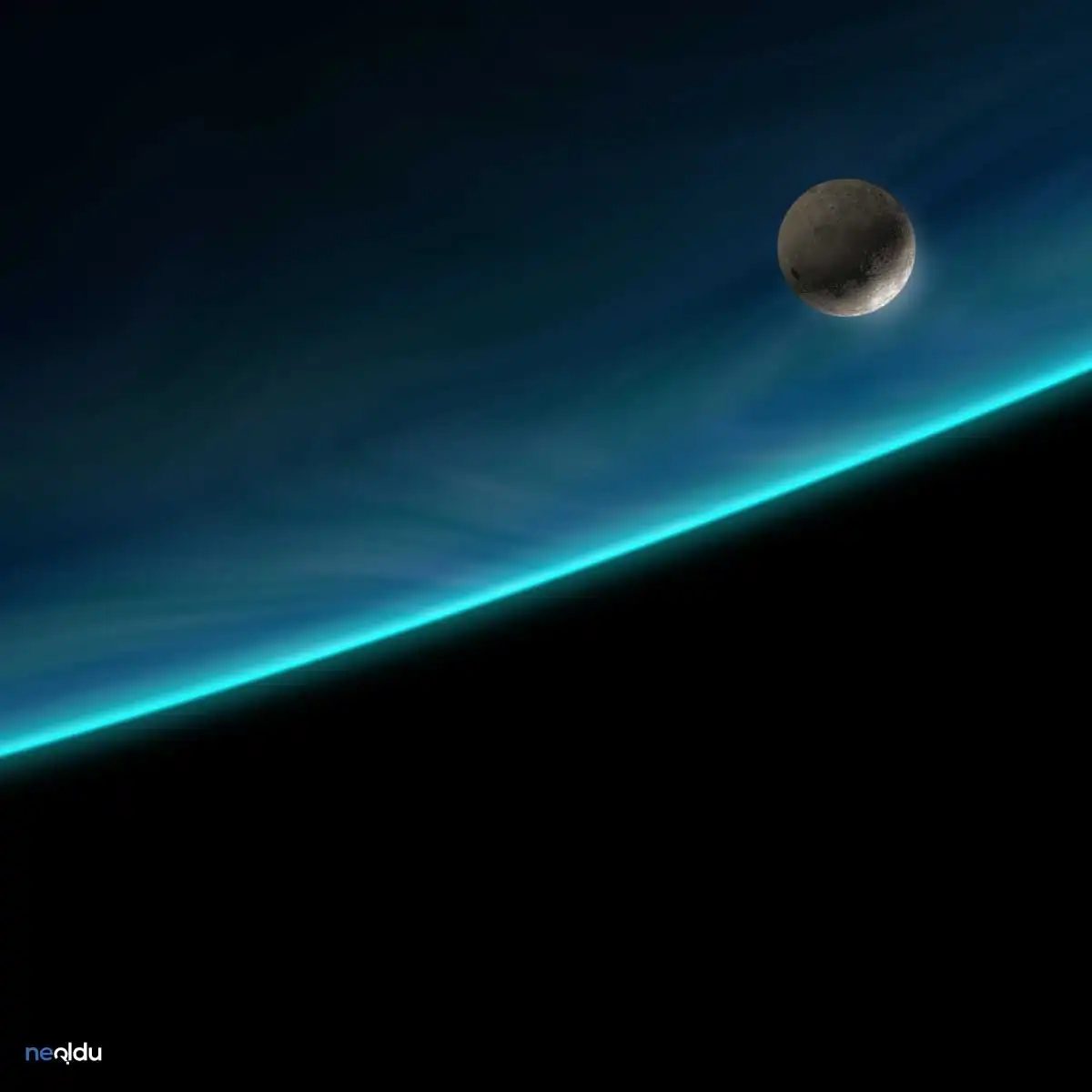
The windiest world in the solar system
Neptune holds the title for the most extreme weather conditions we’ve ever mapped. It’s not just cold. It’s violent. The wind here screams more than 2000 kilometers per hour. That’s faster than the fastest gusts on earth. They don’t stop. They don’t slow down. These storms are caused by a steep temperature gradient. Hot air at the equator collides with ice cold air at the poles. The result is a stormy atmosphere that refuses to calm down.
The sky is a deep, electric blue. Not because of water, but because of methane. This gas absorbs red light from the sun. It reflects the blue back into the void. The air is dense under this colorful mist. Mainly hydrogen and helium. But go deeper. The pressure crushes everything. Hydrogen turns into a sea of liquid metal. The temperature rises. Darkness becomes absolute.
Where is Neptune?
People often ask about its place in the lineup. Neptune is the eighth and last planet from the sun. It is the fourth largest planet in the solar system. It lies behind Jupiter, Saturn and Uranus. But size doesn’t make it significant. It is pure energy that it radiates into space. It gives off more heat than it receives from the sun. There’s something going on down there.
The diameter of the planet is about 49,244 kilometers. It’s a gas giant. There is no solid ground to stand on. You would fall forever. The atmosphere is only getting denser. Hotter. Even more crushing. Until the weight of the planet itself crushes you.
Why is it so blue?
The color comes from this methane layer. It acts like a filter. It removes heat and the red spectrum. What remains is a cold, blue ghost. This methane also plays a role in temperature. It stores heat deep inside, while only a small amount of light reaches the lower layers. The surface temperature is about -200°C. It is one of the coldest places in the region.
But the core is different. The pressure and heat compress the material into a rocky/icy core. It is a dense heart surrounded by a storm. The storm that never ends.
The Moon of Triton
Neptune has a number of satellites. Fourteen in total. But one stands out. Triton. It is the biggest moon. About 2700 kilometers in diameter. It is the seventh largest moon in the entire solar system. It circles back. Moves backward relative to the planet’s rotation. This suggests that it has been captured. Not formed there. Abducted from the Kuiper belt a long time ago.
The other moons are smaller. Dimmer. Nereid. Proteus. Larissa. They go around in the shadow of giants. They are reminiscent of a chaotic past.
Faint Rings
Yes, it has rings. But they are not like Saturns. You won’t see them with your backyard telescope. They are faint. Dark. Made of ice and dust. They are diffuse patches rather than solid bands. Advanced space telescopes are needed to capture them. They are fragile. They don’t reflect much light. They are there, but they are shy.
The Mystery Beneath
We know the wind. We know the color. We know the cold. But the inside is still a mystery. How does a planet so far from the Sun generate so much heat? Is it residual heat of formation? Or radioactive decay? Or something else? We can’t say for sure. All we can do is watch the storm. And wait for the next probe to come in and tell us what’s going on under the blue skin.