Nuclear energy isn’t just heat. It’s the raw power locked inside the dense cores of atoms. We call these cores atomic nuclei. The energy released when they react is massive. It dwarfs ordinary chemical reactions. Those reactions only move the outer electrons around a atom. Nuclear forces are different. They deal with the heart of the matter.
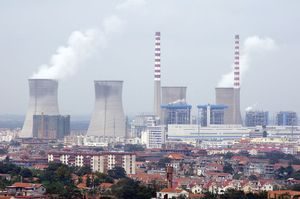
There are two main ways to unlock this power. The first is controlled nuclear fission. This is what we use today. It splits heavy atoms in half. Reactors use this process. They operate in many parts of the world right now. The goal is electricity. We’ve been doing this for decades. It works. It’s reliable. But it’s not the only option.
The second method is controlled nuclear fusion. This joins light atoms together. It’s the same process that powers the sun. Scientists have high hopes for it. But as of 2020, we haven’t perfected it. We can’t yet capture that energy for the grid on a large scale. Fusion holds promise. Fission delivers results.
Both methods can also be explosive. That’s where the danger comes from. Uncontrolled fission or fusion creates bombs. We’ve seen the result. But controlled fission is a different story. It’s a tool for generation. It’s a complex system of physics and engineering.
“One method of releasing nuclear energy is by controlled nuclear fission in devices called reactors, which now operate in many parts of the world for the production of electricity.”
The distinction matters. Chemical energy is weak compared to nuclear energy. You burn coal. You get heat. You split an atom. You get a storm of energy. That’s why nuclear energy is so potent. It’s not about the electron clouds. It’s about the nucleus.
Some people confuse nuclear power with other atomic phenomena. They shouldn’t. Chemical bonds break and form. Nuclear bonds do too. But the energy scales are wildly different. A gram of uranium contains more energy than a ton of coal. That’s the scale we’re talking about.
Fusion is the holy grail. It’s cleaner. It’s safer. It uses abundant fuel. But it’s hard. Keeping plasma stable is a nightmare. We haven’t solved it yet. So we stick with fission. It’s proven. It’s everywhere. But the dream of fusion remains. It’s a promise kept in the future.
Where does this leave us? We have power now. We have a better option on the horizon. The technology exists. The infrastructure is built. The next step is just waiting for physics to catch up.

The Split and The Merge
Nuclear fission isn’t just a split. It’s a shatter.
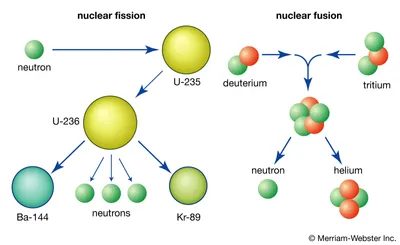
When a heavy nucleus like uranium or plutonium breaks apart, it doesn’t just divide. It explodes into two lighter nuclei. Roughly equal mass. But the energy release is anything but balanced. A massive amount of power comes with the split. Radioactive byproducts form. Neutrons fly out.
Here is the critical part. Those ejected neutrons. They don’t just vanish. They hit nearby fissionable nuclei. They cause those atoms to break too. More neutrons. More splits. The chain reaction is self-sustaining.
Control this chain, and you get a nuclear reactor. Steady power. Light. Heat. Society runs on it.
Let it go, and you get an atomic bomb. Unchecked explosion. Destructive force that rewrites history in seconds.
The physics is simple. The implications are terrifying.
The Fusion Dream
Fusion is the opposite of fission. It is a merger.
Light elements combine to form heavier ones. Think hydrogen. Or its isotopes, deuterium and tritium. When these nuclei collide under extreme pressure and heat, they fuse. The resulting energy output is substantial.
It is far more potent than fission.
We saw the raw power of fusion first in thermonuclear weapons. Hydrogen bombs. Developed in the decade following World War II. The potential for peace, however, proved harder to crack.
Why hasn’t fusion powered our homes yet?
The conditions are brutal. You need plasma temperatures that rival the core of the sun. You need heat insulation that can contain that chaos. It is not about finding fuel. The supply of fusion fuel on Earth is essentially limitless. It is about containment.
We are closer than we have ever been.
Scientists have largely achieved the necessary plasma temperatures. The magnetic and inertial confinement methods are working in labs. Practical reactors are not yet built. But the path is clear.
Why This Matters Now
The promise of commercial fusion reactors is not just technical. It is existential.
An inexhaustible source of electricity. That changes the geopolitical map. No more fighting over oil fields. No more reliance on finite uranium stocks.
Countries worldwide would have access to clean, dense energy. The climate crisis loses its primary driver.
It is not a magic wand. The engineering challenges remain steep. But the direction is set.
Fission split the atom. Fusion wants to put it back together. The first gave us a choice between power and destruction. The second promises a future without that binary choice.
We are watching the experiments. Waiting for the grid connection.
The sun runs on fusion. We just need to build a second sun. On Earth.